TikTok cultures in Australia - TLDR, there are none!
Professor Jean Burgess introducing the team
On the final day of the AANZCA conference 2025 a team of researchers presented some preliminary results of their ongoing research into Australian TikTok culture (if there is such a thing). The project is about making sense of algorithmic culture on TikTok in the Australian context.
The research project has an interesting three-pronged approach where some team members are analysing the TikTok platform, others are investigating audiences, and other researchers are speaking directly to TikTok creators.
Below are some of the things I took away from the presentation. This is not a comprehensive summary or review of the presentation or the project. A lot was said, much more than what I write about below. If you want project details from the team members themselves, you can find them here. I am sure they would love people reaching out and asking questions.
TikTok Baseline
An initial challenge was to somehow get the researchers outside of their own TikTok “bubble”. Any interaction with TikTok began the process of algorithmic personalisation. This led to the strategy of identifying a TikTok baseline. Which may not be called baseline in the future.
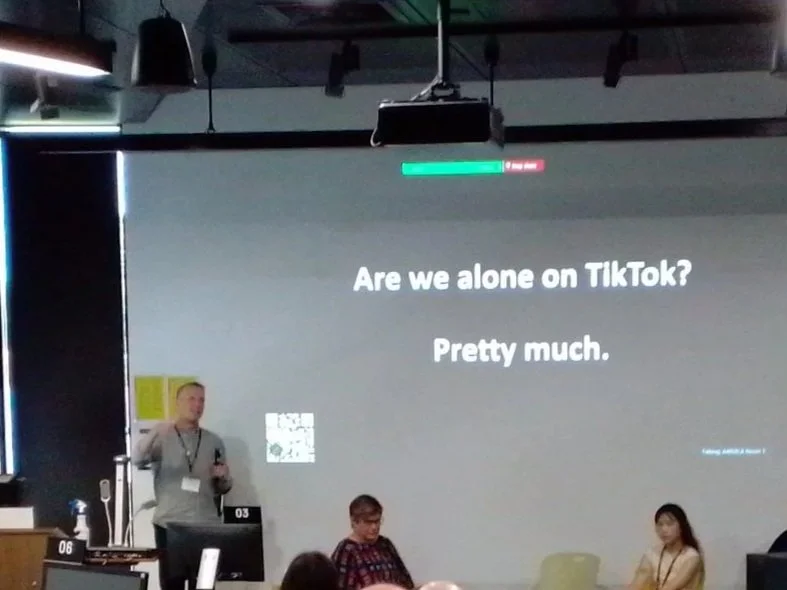
“The culture we share is advertising”
- Patrik Wikstrom
TikTok audience
One of the most interesting aspects of this project for me is the way they are studying TikTok users. A big part of this is through data donation. This is where users download the immense amount of data that TikTok has saved about them. The then donate the data to the researchers. This data includes things like:
every video the user has watched and when they watched it
all the videos they liked and commented on
The early analysis suggests that there is no real Australian culture, or “tribe” on TikTok and that the most common type of content people see on TikTok is advertising.
The research team does more than just “extract” the data from participants. They also educate participants by improving data literacy and helping people understand the data that TikTok saves. I think this is great.
The presenters said they were having trouble recruiting audience volunteers. Though something that helped was teaming up with the ABC to encourage people to be “citizen scientists” and take part in the project. If you want, you can take part in the project here.
Creator interviews
The third stream of the project involves speaking to TikTok creators with more than 150,000 followers. Something I thought was interesting is how the creators self-identified in terms of their profession (the researchers kept referring to them as creators). It turns out that the way the interviewed creators self-identify varies. But it seems that nobody really identifies as a “tiktokker” which I think is fascinating. They generally call themselves a creator, or have some kind of descriptor in front of creator, for example “horror creator”. And others didn’t call themselves creators at all but used some other profession such as comedian.
It was mentioned that interviewees generally prefer focusing on building community rather than obsess over analytics. I think this is interesting and I am looking forward to seeing how these TikTok creators build community. From what I have heard it is a lot harder to build (parasocial)relationships with people con TikTok compared to YouTube.
Something that didn’t surprise me, and is in line with findings in my research, is that Australian TikTok creators find it very hard to make a living from the platform and often see TikTok as part of a “funnel strategy”. That is, TikTok is there to catch audience and hopefully funnel them onto a more profitable platform, such as YouTube.
One last thing. Every day of the AANZCA conference I brought my Fujifilm xt3 and my beautiful 90mm lens. Everyday except when this talk was on! So the images you see here were taken on my cheap-as-chips TCL phone.